Another great piece on Zen Dog Training in the news today!
Friday, January 17, 2014

Thursday, January 16, 2014
Interview: Alexis Toriello Of Zen Dog Talks Training, Communication & The Best Pizza In Town
I was interviewed and featured on Park Slope Stoop today, check it out!
Alexis Toriello Of Zen Dog Talks Training, Communication & The Best Pizza In Town
Wednesday, January 8, 2014
3 Common Dog Behavior Problems Solved.
Everything your dog does has a purpose. Think of a behavior you want to change. Identify its purpose. Show your dog that she can achieve this purpose with an easier and/or more purposeful behavior than the one you want to eliminate. That's dog training, plain and simple.
Here are some examples:
1. Your dog pulls on the leash.
Purpose of pulling on the leash, for your dog: To move forward.
The behavior you'd prefer to result in moving forward: Walking on a loose leash.
Solution: When the leash is loose, move forward faster. When the leash is tight, i.e. your dog is pulling, don't move forward at all.
Result: Dog learns that he can exert less energy to move forward AND move forward more efficiently by walking next to you than by exerting a lot of energy pulling on the leash. This will become his default behavior.
2. Your dog jumps on you.
Purpose of jumping on you, for your dog: Food and/or attention.
The behavior you'd prefer to result in food and/or attention: Calmly lying on dog bed.
Solution: Only give her food or attention when she's lying calmly on her dog bed. Ignore her when she's jumping on you.
Result: Dog learns that she can exert less energy to get food and/or attention by lying calmly on her dog bed than by exerting a lot of energy jumping on you.
3. Your dog chews your shoes.
Purpose of chewing your shoes: It feels good.
The behavior you'd prefer to result in that good feeling: Chewing on appropriate things.
Solution: Make sure your dog likes the chews you're giving him more than your shoes. Then associate chewing on his own things with the sight of your shoes. I.e., dog sees shoes, dog gets kong filled with peanut butter. Dog sees shoes, dog gets braided bully stick. Dog sees shoes, dog gets frozen marrow bone. Dog sees shoes, dog gets squeaky stuffed toy. Remove your shoes from his vicinity when you're not around so he loses the memory of how good it felt to chew on them, and they only remind him of how good it is to chew on his own things.
Result: Dog learns that chewing on his own things feels good. Having your shoes around reminds him that chewing on his own things feels good. Having your shoes around makes him want to chew on his own things.

Here are some examples:
1. Your dog pulls on the leash.
Purpose of pulling on the leash, for your dog: To move forward.
The behavior you'd prefer to result in moving forward: Walking on a loose leash.
Solution: When the leash is loose, move forward faster. When the leash is tight, i.e. your dog is pulling, don't move forward at all.
Result: Dog learns that he can exert less energy to move forward AND move forward more efficiently by walking next to you than by exerting a lot of energy pulling on the leash. This will become his default behavior.
2. Your dog jumps on you.
Purpose of jumping on you, for your dog: Food and/or attention.
The behavior you'd prefer to result in food and/or attention: Calmly lying on dog bed.
Solution: Only give her food or attention when she's lying calmly on her dog bed. Ignore her when she's jumping on you.
Result: Dog learns that she can exert less energy to get food and/or attention by lying calmly on her dog bed than by exerting a lot of energy jumping on you.
3. Your dog chews your shoes.
Purpose of chewing your shoes: It feels good.
The behavior you'd prefer to result in that good feeling: Chewing on appropriate things.
Solution: Make sure your dog likes the chews you're giving him more than your shoes. Then associate chewing on his own things with the sight of your shoes. I.e., dog sees shoes, dog gets kong filled with peanut butter. Dog sees shoes, dog gets braided bully stick. Dog sees shoes, dog gets frozen marrow bone. Dog sees shoes, dog gets squeaky stuffed toy. Remove your shoes from his vicinity when you're not around so he loses the memory of how good it felt to chew on them, and they only remind him of how good it is to chew on his own things.
Result: Dog learns that chewing on his own things feels good. Having your shoes around reminds him that chewing on his own things feels good. Having your shoes around makes him want to chew on his own things.

Monday, January 6, 2014
Pet Parents or Pet Owners?
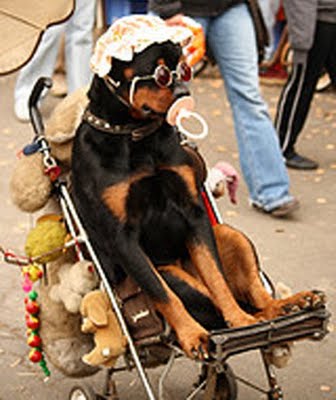
There's been a general push by the pet industry to market the idea of "pet parenting." This includes encouraging pets to sleep in our beds, eat gourmet food, and engage in other such practices that are usually only reserved for the human members of our families. Also, it means putting the same amount and type of resources into pet care as we do for child care.

The foundation for this concept has clearly existed for quite some time. Pet owners do owe their pets proper love and care for the duration of their lives - that is the pact we make when we take ownership of them. That means that throughout financial hardships, life changes and other bumps in the road, we still have to provide for our pets. For this reason, the pet industry has long been considered "recession-proof." But companies like Petco and PetSmart are taking this to a new level. They want to grow and solidify their business, so they're upping the ante for human investment in their furry counterparts.
But what does the concept of "pet parenting" mean, really? This article in Slate talks about the implications. I think there's certainly some merit to the author's argument that pet owning and parenting a child should be separate ideas. But, I see pet parenting as a separate thing from parenting already. Dogs have different needs than children, obviously. Pets play a different role in our lives than our kids do, for sure. But does that mean that we still don't parent our pets, in a way? We still have to equip them to live in the world comfortably and efficiently. We have to provide for their emotional, physical and nutritional needs. Owning a plant is different - we have no obligation to the emotional lives of our plants, but we do need to provide it with nutrition and physical safety. So those two things might be the defining factors of "parenting" -- providing for emotional well-being and instruction on how to exist in the world, both of which we do for our dogs and cats as well as for our kids.
Friday, January 3, 2014
Salty Paws Solution
Booties.
I live near Prospect Park. I took advantage of the snow day to bring my dog to the meadow to romp in the snow (which he loves - he's truly a sight to behold). I saw at least three people on the sidewalks carrying their dogs (one definitely over 60 lbs) to avoid the salt stinging their poor paws. I would have done the same exact thing.
BUT, my dog was wearing booties. And I did my homework - the best booties are the ones WITH VELCRO. All other ones will come off. My dog has houdini-ed his way out of many a bootie. True, running in 2 feet of snow in a meadow will knock off any kind of doggie footwear, but I take off the booties when we get to the meadow because there's no salt there anyway.
If your dog has paw sensitivity issues, there is definitely hope. My own dog would cower and hide when he sensed I was even thinking about coming within a foot of his paws. With a little desensitization and counterconditioning, we worked through it, and now I put his booties on by tapping each leg one by one and saying "Lift." It can be done.
And now, here's a hilarious video of dogs wearing booties for the first time. Don't worry, they get used to it.

I live near Prospect Park. I took advantage of the snow day to bring my dog to the meadow to romp in the snow (which he loves - he's truly a sight to behold). I saw at least three people on the sidewalks carrying their dogs (one definitely over 60 lbs) to avoid the salt stinging their poor paws. I would have done the same exact thing.
BUT, my dog was wearing booties. And I did my homework - the best booties are the ones WITH VELCRO. All other ones will come off. My dog has houdini-ed his way out of many a bootie. True, running in 2 feet of snow in a meadow will knock off any kind of doggie footwear, but I take off the booties when we get to the meadow because there's no salt there anyway.
If your dog has paw sensitivity issues, there is definitely hope. My own dog would cower and hide when he sensed I was even thinking about coming within a foot of his paws. With a little desensitization and counterconditioning, we worked through it, and now I put his booties on by tapping each leg one by one and saying "Lift." It can be done.
And now, here's a hilarious video of dogs wearing booties for the first time. Don't worry, they get used to it.

Tuesday, December 31, 2013
When teaching cute tricks backfire
I love Dr. Sophia Yin. She's brilliant. Here she is teaching her dog to fetch a tissue when she sneezes. Cute! But, I can see how this could backfire. How? When the dog doesn't realize this behavior is only good when it's requested, not offered. This is crucial. Otherwise, when her dog sees that she has something he wants, he'll resort to what all dogs resort to - trying all the tools in his toolbox to earn access to it, including fetching tissues. That could be messy!
I had an unfortunate experience with a cute behavior recently. I was in the process of teaching my dog Riis to push my baby daughter's swing. However, I hadn't gotten to the point where we were putting it on cue yet. So, one day, my husband had just spent 45 minutes getting our daughter to sleep, and placed her carefully in the swing so as not to wake her. What does Riis do? He goes right over and bumps the swing with his nose, swinging it like a champ, and waking up the baby. Needless to say, my husband did not think that trick was very cute.
You might have had this problem with teaching your dog "Paw" or "Shake." Often they start to paw at you whenever they want your attention. It is important not to reward this, and to reward only when you ask for it! Not only will this get rid of the annoying unsolicited pawing, but it will teach your dog that she needs to take advantage of the opportunity to earn a treat when you ask her for something. It will make her that much more attentive to you.

I had an unfortunate experience with a cute behavior recently. I was in the process of teaching my dog Riis to push my baby daughter's swing. However, I hadn't gotten to the point where we were putting it on cue yet. So, one day, my husband had just spent 45 minutes getting our daughter to sleep, and placed her carefully in the swing so as not to wake her. What does Riis do? He goes right over and bumps the swing with his nose, swinging it like a champ, and waking up the baby. Needless to say, my husband did not think that trick was very cute.
You might have had this problem with teaching your dog "Paw" or "Shake." Often they start to paw at you whenever they want your attention. It is important not to reward this, and to reward only when you ask for it! Not only will this get rid of the annoying unsolicited pawing, but it will teach your dog that she needs to take advantage of the opportunity to earn a treat when you ask her for something. It will make her that much more attentive to you.
Tuesday, December 24, 2013
Dog-Human Translator??
Yesterday I came across this article about a device in beta that will translate your dog's thoughts into simple phrases that you can understand. An EKG reads his brain waves and spits out phrases to reflect what he's feeling, like "This is splendid!" "Leave me alone." "I am so very weary." "Who are you?" "Em, why are you guys leaving?" "Is that really you?" "Night-time!" and "He must be a very nice animal."
I wonder what dog owners will think of this. I, for one, am skeptical. Not just because if it were to be successful, it could put trainers like me out of a job (!!) but because I honestly don't see how it could work. For example, when my dog is confused, he gets frustrated. Could a device like this translate that as anger, when the real issue is that he's confused? I could see that creating a real communication breakdown instead of being an assistance.
On the other hand, the "Leave me alone" phrase could potentially be quite helpful. Imagine how many dog bites would have been avoided if the dog could just say those three words. Especially to children. So, I suppose there could be some value to this. But still, I'm more skeptical than not.
What do you think?
Subscribe to:
Posts (Atom)